I had to go see the Philip K. Dick inspired Steven Spielberg spectacle on opening night. I really enjoyed it, especially the action scenes, even though it had a couple of standard Spielberg-over-the-top-emotional moments. (cry now, dammit, now!) He really brought to life a future that seems entirely possible, but I couldn't decide how he felt about it. It wasn't quite the dystopia of Blade Runner, though it had some dark elements. He seemed to be envisioning a future where corporate control and constant surveillance isn't so bad. In fact, he showed that it's kind of cute and funny to have the police dropping in at all hours sending robotic spiders after you. And even the lowest dregs of bad guys live in fashionable houses furnished by Ikea. The story is what saved the movie from its problems, though, and it brought up some real issues to think about.

It's definitely time to bump another Dick novel up to the top of my reading queue. This time: The Three Stigmata of Palmer Eldritch. (If I can find it at the bookstore today.) Before the show we saw a teaser preview for the movie version of Solaris by Stanislaw Lem coming out in December.


Happy Summer Solstice!

Space Needle
Space Needle

Copper River Salmon
Copper River Salmon at the market in Seattle

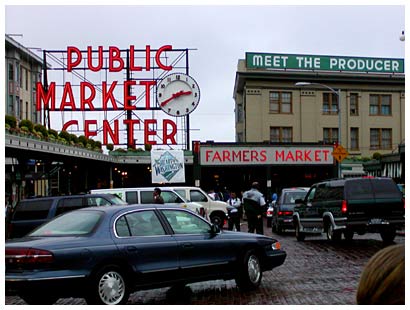
Pike Place Market
Pike Place Market, Seattle, WA

get well soon, Dave. [via Blogroots]

on the road again...

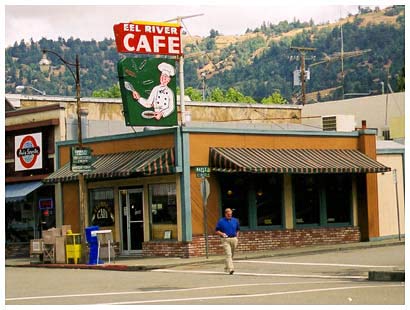
Eel River Cafe
Eel River Cafe, Garberville, CA

meg on weblogs: "What's important is that we've embraced a medium free of the physical limitations of pages, intrusions of editors, and delays of tedious publishing systems. As with free speech itself, what we say isn't as important as the system that enables us to say it."

Erik Benson is doing some interesting things with the Weblog Bookwatch RSS feed (+ an Amazon SCRAPI, + Google's API). I like the related books feature.

butterfly

Can the RIAA have its name attached to something good? The Future of Music Coalition has joined together with several groups, including the RIAA, in a letter to the FCC and Congress. The letter proposes (among other things) that the FCC allow independent low-power FM stations. It also laments the effect that corporate consolidation has had on the airwaves: "Radio station groups have centralized their decision-making about playlists and which new songs to add to the playlist. These centralized playlists have reduced the local flavor and limited the diversity of music played on radio." With all of the work RIAA has done to stop independent musicians and Internet radio stations, this letter doesn't seem to be in line with their strategy. I guess it's another case of saying one thing publicly and acting completely different in the courts.

Update: Senator Feingold (campaign finance reformer) has seized on this issue and says he's going to introduce legistlation to change the current radio landscape. From his statement to congress: "Radio airwaves are public property. Unlike other business ventures, radio stations have acquired their distribution mechanisms – the airways – without any expenditure of capital. They were given access to the broadcast spectrum by the government for free. Since 1943, Congress and the Federal Communications Commission have tried to ensure that this medium serves public good, but limiting access to information and diversity on the radio does not achieve this." (6/15)
« Older posts  /  Newer posts »